Interest Rates Are on the Rise
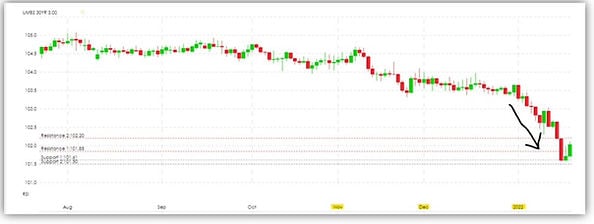
Interest rates are on the rise. While we saw them slowly and slightly starting to move upward in the last two months of last year, when the market opened for the first time in 2022 it started to take a sharp and accelerated turn in the wrong direction. Below is a snippet from the software I have open every day tracking the price of the Mortgage Backed Securities (MBS) bond pricing. This is the number one driver of interest rates rising or falling. MBS pricing has an inverse relationship with interest rates. As bond prices fall, interest rates go up. While the movement below may not look like a lot, for us to see this much of a drop in this short of time is pretty significant. As I am writing this on January 20th you will see that yesterday and today have seen some bounce back to our favor. But the overall trend and outlook is for it to continue to move in the wrong direction.
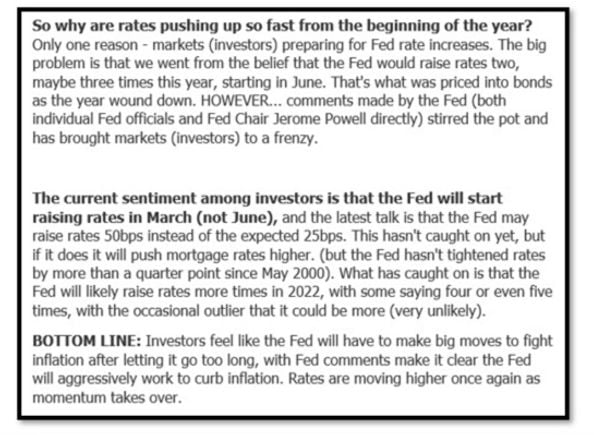
So why is this happening now? While there are a few different factors driving this movement, inflation and the economy being 2 of them, the biggest reason we are seeing is investors’ reaction to the Federal Reserve. The Fed, to use its short name, has announced multiple rate increases this year and a pullback of its bond-buying program. Let’s start with the rate increases. The Fed sets the rate at which banks and other depository institutions lend money to each other on a short term basis. For the last couple of years this rate has been at about zero. When the Fed lowers or raises this rate, it does not directly affect your mortgage interest rate. Rates that are affected by this that most people see would be credit card rates and home equity lines of credit (HELOC). Well the Fed has announced multiple increases to this rate this year. Most commonly this is done at ¼% increases, and not expected until mid year, there is now a belief that it could be larger increases and start sooner. So the investors reacted quickly and sharply to this sentiment. See news snippet below which better explains this point. The other Fed related issue is their bond buying. The Fed has bought an enormous amount of MBS bonds over the last couple years keeping bond pricing artificially higher. And as I mentioned above about their inverse relationship to interest rates, this has been helping us see such historically low rates over the last 2 years. So as they pull back on this and new investors don’t buy in, or also sell their bonds, prices drop and rates go up. So this is why we are seeing the graph above look the way it does.
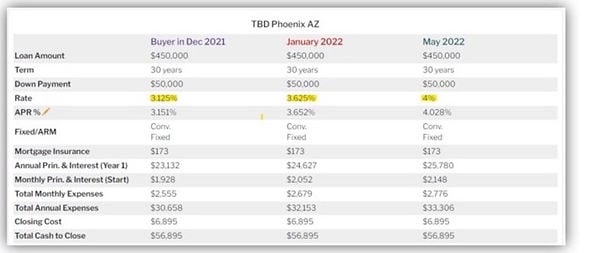
So what does this all mean for someone looking to buy now versus a month ago or 6 months from now? Below are a few illustrations of this using a $500,000 sales price with a 10% down payment, and 720+ credit scores, in the metro Phoenix area. As recently as mid-December, we were at 3.125% on a 30-year fixed rate. As of this week, we are already up to 3.625%, and if this trend does in fact continue, we could be at 4.00% or higher by the start of summer. You can see the cost increase to you with higher rates, plus the monthly payment difference. But I feel the biggest impact of higher rates is shown in the last illustration below. When you look at the thousands of dollars more you will pay just over the first 5 years of the loan, you see the long-term impact of higher rates.
While we can’t predict what will happen in the coming months, the current trend and all projections point to this continuing. I would love for those projections to be wrong and this course to reverse itself. Believe me, talking to clients about rates at 3.00% or lower has been so nice the last couple of years. A footnote to all of this that could possibly reverse the course of rates is the growing conflict with Russia over Ukraine. If this were to escalate and develop into something more, and I pray that it doesn't, you could see bond prices trend back in our favor and rates drop some. The reason for this is that Wall Street does not like uncertainty. War, or the threat of war or conflict, creates uncertainty in the markets. The bond market is seen as the safer investment when there is uncertainty like this. So if Russia does invade Ukraine and the US is forced to act, you could see investors pull their money out of the stock market and put it into the safer bond market, giving us a temporary drop in rates. Please know I don’t dismiss the significance of this possible conflict, and I do truly hope this resolves itself without a shot fired. But it is something on the horizon that could impact rates. So I wanted to make sure you were aware of it. If you have any questions on this or if you would like to discuss further, please reach out to me... I would love the opportunity to discuss your options and answer any questions.
Stay up to date on the latest real estate trends.

New listings remain stubbornly low, especially in the price ranges that are most popular with buyers.

Looking for things to do around the valley this month? Look no further.

Supply remains lower than last year, but the gap closed slightly.
Understand why mortgage interest rates are climbing and what it means for your home buying plans.

Explore the latest real estate trends and price per square foot growth across various Arizona cities.

This is truly the most important question to answer. Forget the finances for a minute.

Discover why professional home staging is essential for attracting buyers.

Navigate the shifting Greater Phoenix real estate market with insights on price trends.

Don't let dated fixtures scare away potential buyers. Learn how to update your home's finishes.
At The Raegen Johnson Group, real estate has always been about more than buying or selling a home. It’s about the people, the relationships we build, and the trust we’re honored to earn. Every client becomes part of our story, and every relationship is one we cherish long after closing day.

THE RAEGEN JOHNSON GROUP
REAL BROKERAGE LLC
(602) 330-5362
[email protected]
3707 E Southern Ave STE 1074 Mesa AZ, 85206