How Much Cash Will A Smart Thermostat Save You?
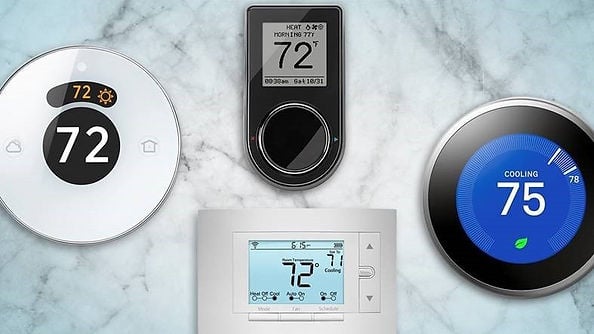
All the fancy smart thermostats on the market look great and promise to save you money. But are they really the energy misers that they claim to be? And at a price that is several times more than a typical programmable thermostat, is it really worth it?
How Much Is The Average Savings With A Smart Thermostat?
A study by Nest concluded that customers saved an average of 10 to 12 percent on heating costs and 15 percent on air conditioning costs. This isn’t just some throwaway study done by Nest to make themselves look good either. In fact, there have been two more independent studies of Nest thermostat usage that found similar savings.
Another leading smart thermostat, the Ecobee3, makes some bold claims on energy savings. Ecobee claims that their Ecobee3 can save you up to 23% on your energy bills. Their claim is based on a household that leaves their current thermostat set to a constant temperature of 72°F year-round.
The amount an individual household saves can vary quite a bit depending on your existing situation and thermostat habits. Here is a list of a few calculators that will give you an idea of how much you can save:
A smart thermostat isn’t some mystical device that changes the laws of physics in order to use less energy. The only way to spend less is to heat or cool less. It will save you money by setting temperatures higher during cooling and lower during heating. That’s it. Pretty simple, right?
The smart part is deciding when to do it so you don’t notice. It’s always on, watching when you leave and when you come home. It sees you when you’re sleeping; it knows when you’re awake, etc. And the best part is it doesn’t forget, and it doesn’t get lazy.
A typical home in the US can reduce heating and cooling costs as much as 10% by turning the thermostat back 7°-10°F for 8 hours/day from the usual set point. Although this simple setting can be done with just about any thermostat, it turns out that many people don’t do it.
A recent study found that almost 50% of households that own programmable thermostats don’t set them up properly. It might be because they forget, they don’t know how, or they just don’t want to be hassled with it. Regardless of the reason, a smart thermostat never forgets, always knows how to adjust your temperature, and always cares because that is exactly its purpose and that is how it saves you money.
Are you a set-it-and-forget thermostat operator or do you micro-manage your thermostat?
The households that will save the most money are the ones that either
If you are already the thermostat micro-manager, then you will probably not experience much savings with a shiny new smart thermostat. However, that doesn’t mean a smart thermostat is completely useless to you. There are other benefits that may prove it to still be a worthwhile investment.
Before the smart thermostat era, programmable thermostats were not recommended for use with heat pumps. Heat pumps take a lot longer to heat or cool a space compared to conventional heating equipment. In order to make up for this, most heat pump systems are installed with an auxiliary electric resistance heater that is designed to kick in during extreme weather events when the heat pump system alone cannot keep up.
Unfortunately, the auxiliary heater is much less efficient than the heat pump. Therefore, it is best to avoid using the auxiliary heat whenever possible. If you try to use a conventional programmable thermostat with a heat pump, it will tend to trigger the inefficient auxiliary heat unnecessarily and therefore possibly end up costing you more money.
Fortunately, the new breed of smart thermostats can anticipate this sort of dilemma. Thermostats like the Nest and Ecobee3 can start the heat pump up to 5 hours early so that you can reach your desired set point at the correct time using only the heat pump.
I know this article is supposed to be about the amount of cold hard cash these thermostats can save, but I think it’s worth considering other benefits. Different people place different values on things like convenience and comfort. But, just because we can’t put an exact number on it doesn’t mean they don’t have some monetary value, right?
A smart thermostat can save some energy for all but the most dedicated thermostat micro-manager. However, if you are buying the thermostat with the hope of it paying for itself through reduced energy bills, you may end up disappointed. But, if you consider the convenience and comfort benefits, it should be easy to justify the added expense of a smart thermostat.
Stay up to date on the latest real estate trends.

New listings remain stubbornly low, especially in the price ranges that are most popular with buyers.

Looking for things to do around the valley this month? Look no further.

Supply remains lower than last year, but the gap closed slightly.

Understand why mortgage interest rates are climbing and what it means for your home buying plans.

Explore the latest real estate trends and price per square foot growth across various Arizona cities.

This is truly the most important question to answer. Forget the finances for a minute.

Discover why professional home staging is essential for attracting buyers.

Navigate the shifting Greater Phoenix real estate market with insights on price trends.

Don't let dated fixtures scare away potential buyers. Learn how to update your home's finishes.
At The Raegen Johnson Group, real estate has always been about more than buying or selling a home. It’s about the people, the relationships we build, and the trust we’re honored to earn. Every client becomes part of our story, and every relationship is one we cherish long after closing day.

THE RAEGEN JOHNSON GROUP
REAL BROKERAGE LLC
(602) 330-5362
[email protected]
3707 E Southern Ave STE 1074 Mesa AZ, 85206